A Data Infrastructure Roadmap for Preventing Youth Homelessness

Table of Contents

Overview

About forty percent of individuals in Canada who face homelessness say that their first experience happened before age 16.

They are stuck early in a pattern of repeated homelessness that could be avoidable by ‘making the shift’ from current crisis-oriented responses to one emphasizing prevention.

To better support youth while preventing homelessness, we designed a plan to build and use information across Canada. We sought to connect governments, community organizations, and researchers to information. This information can help create better policies and research. And most importantly, it can help reduce homelessness.

We led activities in partnership with Dr. Yale Belanger and Making the Shift. Learning from previous practices, we co-designed the plan with interest holders across the homelessness sector. Youth with lived experiences of homelessness, Indigenous communities, and front-line organizations are central to our process.

Together, we are making the shift to prevent youth homelessness in Canada.

Roadmap Resources

Summary Report: A Roadmap for Youth Homelessness Prevention Data Infrastructure (Feb 2025)

The Summary Report reflects three years of community engagement in developing our co-created roadmap for youth homelessness prevention data infrastructure. The roadmap includes four recommendations for interest holders:

  1. Build quality community engagement
  2. Support better data collection and use
  3. Support collaboration around prevention
  4. Build up data for youth homelessness prevention

For each recommendation, we also provide immediate and long-term actions interest holders can take to prevent youth homelessness.

Summary Report

Final Report: A Roadmap for Youth Homelessness Prevention Data Infrastructure (Feb. 2025)

The Final Report provides our fully detailed roadmap for data infrastructure to support youth homelessness prevention in Canada. In the report, you will find:

  • The seven principles that represent how interest holders wanted the roadmap’s work to be done.
  • Details on our four recommendations for interest holders to prevent youth homelessness:
    1. Build quality community engagement
    2. Support better data collection and use
    3. Support collaboration around prevention
    4. Build up data for youth homelessness prevention
  • A comprehensive list of suggested actions interest holders can take immediately and in the long term to implement our recommendations.
Final Report

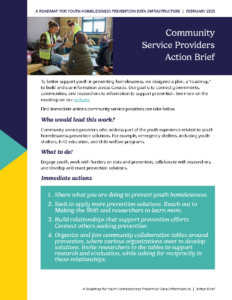
Interest Holder Briefs (Feb 2025)

These five Interest Holder Briefs discuss immediate actions each interest holder can take to improve data infrastructure to support youth homelessness prevention.

These actions are based on our recommendations found in our Summary and Final Reports above.

There are briefs linked below to five interest holder groups:

  1. Community Service Providers
  2. Decision Makers from the Government and Funders
  3. Researchers
  4. Youth
  5. Youth Homelessness Prevention Leadership
Interest Holder Brief

Supplementary Reports

Supplementary Report 1: Canadian Data Infrastructure (Dec. 2022 – Feb. 2023)
This supplementary report shares what we learned about the state of existing Canadian administrative data infrastructure that could support our roadmap for data infrastructure to inform Canadian youth homelessness prevention.

Administrative data is information collected by organizations for their operations. It can be linked to other information to help predict and prevent homelessness.

Supplementary Report 1:
Canadian Data Infrastructure

Supplementary Report 2: Project Interviews (Feb. – Mar. 2023)

This supplementary report shares our analysis of interviews with current Making the Shift project team members.

We focused on their projects that contained administrative data infrastructure. We also looked at other projects that covered a range of methods that inform the prevention of youth homelessness.

Supplementary Report 2 Preventing Youth Homelessness
Supplementary Report 2:
Project Interviews

Supplementary Report 3: Promising Practices Literature Review (Jan. – Feb. 2023)

This supplementary report shares our literature review on promising practices for administrative data to help prevent youth homelessness. We reviewed literature that used homelessness-related health and social data from:

  • Academia
  • Federal, provincial, and municipal governments
  • Non-profit organizations
  • Social-serving organizations

Our focus extended to literature from Canada, the United Kingdom, Australia, New Zealand, and Europe.

Supplementary Report 3 Preventing Youth Homelessness
Supplementary Report 3:
Promising Practices Literature Review

Supplementary Report 4: Community Service Provider Interviews (Feb. – Aug. 2023)
This supplementary report shares our analysis of interviews with community service providers supporting youth facing homelessness.

Through these interviews, we sought to learn about how they use information to support youth experiencing or at risk of homelessness or housing instability.

Supplementary Report 4
Supplementary Report 4:
Community Service Provider Interviews

Supplementary Report 5: Youth Focus Groups (Sep. 2023)

This supplementary report shares our analysis of focus groups with youth who have lived experience of homelessness.

We held these youth focus groups to learn their thoughts on information collection, use, and sharing when seeking housing supports.

Supplementary Report 5
Supplementary Report 5:
Youth Focus Groups

Supplementary Report 6: Canadian Policy Scan (Jan. – Feb. 2024)

This supplementary report shares what we learned about recent Canadian policies and how they relate to project findings. 

We sought to understand Canadian policies on homelessness and housing instability, looking at:

  1. Key guiding principles
  2. Approaches to youth homelessness prevention and intervention
  3. Connections to data
  4. Strategies for sectoral relations and collaborations
Supplementary Report 6 Preventing Youth Homelessness
Supplementary Report 6:
Canadian Policy Scan

Participatory Design in the Co-Creation of a Roadmap for Information for Youth Homelessness Prevention (Feb. 2026)

The project team, with Mardi Daley and Dr. Yale Belanger, published an article in the International Journal on Homelessness about how they built the Roadmap for information to prevent youth homelessness.

The article shows how youth with lived experience, service providers, researchers, policy makers, Indigenous communities, and other partners helped create the Roadmap. It explains why inclusion, trust, and shared decisions matter when groups build information systems to help prevent youth homelessness.

If you want to learn more about how the project team and their collaborators built the Roadmap, you can read the article here.

Towards youth-centred information practices to support youth facing homelessness: experiences and perspectives of youth with lived experience and community service providers (Apr. 2025)

The Roadmap project team and its collaborators published an article in the Journal of Social Distress and Homelessness.

The article, grounded in the Roadmap’s research, examines how information practices impact youth experiencing homelessness when accessing services. By drawing on interviews and focus groups with youth and service providers, it identifies trust, safety, and consent as crucial factors. The study also emphasizes that information we collect must align with real-world service delivery. These findings directly influenced the Roadmap’s advocacy for ethical, youth-informed, and practical information approaches.

If you want to dive deep into the data infrastructure roadmap, you can find that article here.

Related Resources

Towards Youth-Centred Data Practices for Ending Youth Homelessness (Aug. 2025)

The Homeless Hub published a blog post about key findings from youth and community learning in the Roadmap project. The blog is based on an article written by the project team and collaborators in the Journal of Social Distress and Homelessness.

The post shares the article’s main findings in plain language. It explains why trust, safety, clear consent, and respect for identity matter when services collect and use information. It also offers practical ideas for improving data infrastructure, or how organizations collect, share, and use information, so services can better support youth experiencing homelessness.

If you want to learn more about the article’s findings and what they mean for practice, you can read the blog post here.

Designing Data Infrastructure to Prevent Youth Homelessness in Canada (Nov. 2023)

The homelessness sector spans jurisdictions, disciplines, and a variety of other dimensions. 

In this video, learn about a project that seeks to enable all stakeholders, from funders and policy makers to program staff and service users, to visualize, interrogate, and improve the functioning of the homelessness system by identifying and connecting existing data assets. 

PolicyWise’s Matthew Russell shares how this project is designing data infrastructure with youth in mind.

Looking Ahead: MtS Research in Progress Data-Informed Solutions to Support Communities Across Canada (Dec. 2022)

Our partner, Making the Shift, sat down with Dr. Yale Belenager, a Professor of Political Science at Lethbridge University, and Robyn Blackadar, the former President & CEO of PolicyWise for Children & Families, to discuss our project.

Read the article here.

Acknowledgments

We thank the individuals and organizations who collaborated with us and contributed their wisdom, experience, and perspectives to this project. Specifically, we would like to acknowledge the advisory team members, the youth with lived experience, other interest holders, and leaders in data use who generously shared their experiences with us.

Project Team

Matthew Russell, PhD, Senior Research & Policy Associate, PolicyWise for Children & Families
Sakiko Yamaguchi, PhD, Mitacs Intern & Postdoctoral Fellow, PolicyWise for Children & Families
Shiva Zarezadeh Kheibari, PhD, Research & Policy Associate, PolicyWise for Children & Families
Falynn Bilyk, MPH, Research & Policy Associate, PolicyWise for Children & Families
Fatima Mustafa, PhD, Data Management Analyst, PolicyWise for Children & Families
Troy Rhoades, PhD, Communications & Government Relations Specialist, PolicyWise for Children & Families
Mardi Daley, Founder, Lived Experience Lab

Investigator Team

Yale Belanger, PhD, Professor, University of Lethbridge
Liana Urichuk, PhD, Chief Operating Officer, PolicyWise for Children & Families
Janice Victor, PhD, Associate Professor, University of Lethbridge
Naomi Nichols, PhD, Associate Professor, Trent University

Project Sponsors

The project was funded by Making the Shift: Youth Homelessness Social Innovation Lab.

Making the Shift is funded by the Government of Canada through the Networks of Centres of Excellence program. The opinions and interpretations in this publication are those of the authors and do not necessarily reflect those of the Government of Canada.