
A new report from PolicyWise and UBC Okanagan’s Dr. Carla Hilario traces the childhood predictors of youth homelessness, and opens the door to earlier prevention.
Looking for the warning signs of youth homelessness
For many young people in British Columbia, homelessness rarely happens without warning. The childhood roots of youth homelessness often reach back years, through contact with child welfare, mental health services, income assistance, schools, and the justice system.
By the time a young person becomes homeless, the warning signs may have been present for many years. The challenge has been connecting those signals into action. Information about young people’s experiences has traditionally been spread across separate government systems, making it difficult to see the full picture or intervene early.
Connecting records across government systems is beginning to change that. In BC, the Data Innovation Program has created new data connections that allow researchers, policy makers, and service providers to follow young people’s experiences over time. These connections offer insights that could help prevent youth homelessness before it begins.
Looking at the data to find the childhood roots of youth homelessness
PolicyWise for Children & Families, in partnership with Dr. Carla Hilario from the University of British Columbia, Okanagan, set out to answer a long-standing question.
What childhood experiences increase the chances that a young person will become homeless as an adult?
To find out, the project team worked with the BC Ministry of Housing and Municipal Affairs and used data from the Data Innovation Program. The project team looked at the experiences of youth ages 13 to 18, and then followed what happened to them from ages 19 to 27.
Records came from five ministries, spanning child welfare, mental health, income assistance, K-12 education, health, and justice. Together, these linked records provided a detailed picture of youth homelessness risk.
The findings challenge the idea that homelessness appears suddenly. Instead, the data shows clear patterns in childhood and adolescence that increase the likelihood of homelessness later.
Four things the research tells us
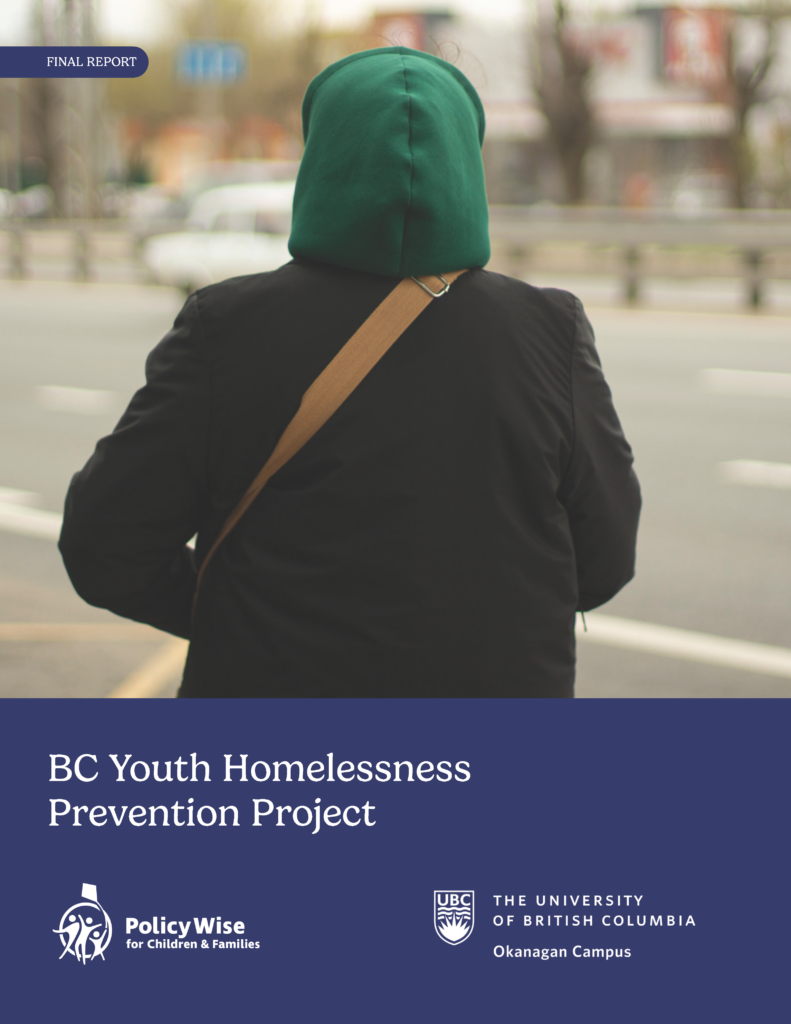
In the team’s recent report, BC Youth Homelessness Prevention Project, they share four areas of findings that help explain how youth homelessness develops and where preventative actions could focus.
First, the scale of the problem is large. About 1% of BC youth experienced homelessness during the study period. However, because the data does not capture everyone who sleeps rough, the team estimates that 9% of youth experienced hidden homelessness between 2015 and 2019.
Second, homelessness rarely appears within a single system. Most youth who have experienced homelessness have also interacted with many of these system’s services.
Third, difficult childhood experiences were strongly linked to later homelessness. Key warning signs included:
- Child welfare involvement
- Not finishing high school
- Family income assistance use
- Mental health support for substance use or schizophrenia, for either the young person or their parent
Finally, the depth of system involvement also mattered. The longer and more frequently a young person had contact with the system’s services, and the more complex their needs, the greater their risk. For example, 2% of children with one mental health diagnosis experienced homelessness, compared with 19% of those with six mental health care diagnoses.
What this means for prevention
Knowing the risks of youth homelessness is only useful if it supports action. To that end, the team developed three policy-related questions:
- Who should prevention efforts focus on?
- What kinds of support make a difference?
- How can better use of information help?
Youth to focus on
Youth connected to four or more systems had the highest risk of homelessness. But since they are already interacting with services, the project team believes these connections also create opportunities for earlier intervention.
Young people involved in child welfare, those managing complex mental health needs, and youth leaving systems such as child welfare, corrections, or substance use treatment all face elevated risk. These transition points can be critical opportunities for prevention.
How to support youth
Getting the right support to young people at the right time is often a challenge. The data showed that youth who used more services tended to have worse outcomes. This suggests the importance of timing and fit rather than simply a lack of services.
Some programs are working to address this gap. Organizations like Housing First for Youth place young people in stable housing with minimal conditions. Upstream Canada uses school-based screening to identify youth who may need support before a crisis develops.
When organizations work together rather than in isolation, young people may face fewer gaps, shorter wait times, and less pressure to navigate complex systems on their own.
Family relationships also matter a lot. Because a family’s circumstances influence a young person’s chance of becoming homeless in many findings, programs that support families alongside youth services may be particularly effective.
Data for prevention
Underlying all of this is how information is used. Better use of information can help staff spot warning signs earlier, coordinate services, and reduce the need for youth to repeat their story across organizations.
The report highlights BC Situation Tables and the Community Information Exchange as examples of responsible information sharing across organizations. It also points to PolicyWise’s Data Infrastructure Roadmap for Preventing Youth Homelessness project, where young people who took part in conversations said they are comfortable with their information being shared when they have agreed to it and when it leads to better support. Monitoring program outcomes is also important, so that services can keep improving.
Part of a bigger effort
The project team emphasizes that these findings are a starting point. They plan to sit down with youth and community members to hear what the results mean to them and what solutions could look like.
This report is part of a growing body of work on youth homelessness prevention in BC and , and is a continuation of PolicyWise’s Data Infrastructure Roadmap for Preventing Youth Homelessness project and is part of their Building Youth Homelessness Data Collaboration project.
Another part of the Building Youth Homelessness Data Collaboration project is developing and testing practical ways for organizations to share information with each other. The project team recently released a report outlining five considerations for organizations when building collaborative information-sharing practices that are safe, meaningful, and youth-centred. Together, these efforts aim to better understand who is at risk and ensure systems are ready to respond.

Take the next step
This report is about those who work with youth, use youth-related data, or design the programs and policies meant to support them. It provides a picture of the childhood roots of youth homelessness and the opportunities for prevention. Read or download the report today.
You can also learn more about the Data Infrastructure Roadmap for Preventing Youth Homelessness project, the Building Youth Homelessness Data Collaboration project, and explore related resources throughout our website.
Project partners
PolicyWise for Children & Families is proud to be collaborating with Dr. Carla Hilario from the University of British Columbia, Okanagan.

Project funding
This project was funded in part by the Government of Canada and the Government of British Columbia.