BC Youth Homelessness Prevention Project
Authors
Matthew Russell, PhD, Senior Research & Policy Associate, PolicyWise for Children & Families
Carla Hilario, PhD, Assistant Professor, School of Nursing, Faculty of Health and Social Development,
University of British Columbia-Okanagan
Rachel Carr, Manager, Strategic Initiatives, PolicyWise for Children & Families
Introduction
Overview
We used data from the BC Data Innovation Program (DIP) to examine childhood predictors of youth homelessness.1 The analysis focused on predictors between the ages of 13 and 18 and how it relates to experiences of homelessness between the ages of 19 and 27, during the years 2019 to 2022.
Predictors came from multiple BC ministries and systems, specifically:
- Ministry of Children and Family Development (MCFD): child welfare involvement and Child and Youth Mental Health (CYMH) service use
- Ministry of Social Development and Poverty Reduction (SDPR): BC Employment and Assistance (BCEA) family income assistance and records of no fixed address
- Ministry of Education and Child Care (ECC): K–12 program participation, inclusive education designations, and high school completion
- Ministry of Health: child and parent mental health and substance use-related health care visits
- Ministry of Public Safety and Solicitor General (PSSG): parent provincial criminal charges and convictions

Our goal was to identify opportunities for early support to prevent youth from becoming homeless.
What was done?
Our team, PolicyWise and Dr. Carla Hilario (University of British Columbia, Okanagan), worked in partnership with the BC Ministry of Housing and Municipal Affairs. The team examined childhood service use patterns associated with known risks for youth homelessness using DIP data linked across datasets for individuals. We explored other service use patterns which informed the patterns discussed in this report. Youth homelessness was defined using the Homelessness Cohort derived in a previous project.2 It is based on the presence of any homeless shelter use or no fixed address for three consecutive months.
To support this work, we created an advisory team consisting of ministry staff from Children and Family Development, Education and Child Care, Health, and Housing and Municipal Affairs. The team met regularly throughout 2025 to discuss the analysis setup, findings, and policy implications. This report reflects both the analysis findings and insights from these discussions. Policy discussions are at an early stage and require further input. To further inform discussions, we plan to engage youth and community members on the findings and share back on what we learn.
What documents are available or planned?
- The Final Report (This document): This report introduces the project, summarizes key findings, and outlines the policy discussion. To support further policy discussion, we share insights from previous community engagement and examples of ongoing work.
- Full Analysis Slide Decks (For Government of British Columbia ministries only): The complete technical analyses in PowerPoint format. They include ministry-specific slides and explanatory notes.
- Academic Manuscript (forthcoming): A peer-reviewed academic manuscript based on a modified version of the main analysis.
- Youth and Community Findings (forthcoming): A brief, summarizing insights from BC youth and community engagement. It will also be developed into an academic manuscript.
Finding Summary
Scope of the project
Our project focused on youths who lived in BC long-term (at the age of 13 and most years from 13 to 27 years old). Our predictors cover 92% of BC youth homelessness seen between 2019 to 2022.
Key Findings
1. Many BC youth face homelessness.
We found that 1% of BC youth experienced homelessness during the analyses period. This is an undercount, as it does not capture rough sleeping and is limited by the years of shelter data available. That said, we estimated that 9% of youth experienced hidden homelessness between 2015 and 2019.3
2. Youth homelessness is linked to involvement with other adult systems.
Most youth who experienced homelessness were also involved with other systems when they were 19-27-years old. Almost all youth (88%) had interactions with three or more systems, and 61% with four or more systems.
For example, for youth who experienced homelessness:
- 95% also received income assistance;
- 65% also had not completed a high school diploma by 27 years old;
- 64% also accessed healthcare for substance use;
- 16% also received a provincial custodial sentence; and,
- 4% died between ages 19 and 27.
3. Youth with complex childhoods were at increased risk of homelessness.
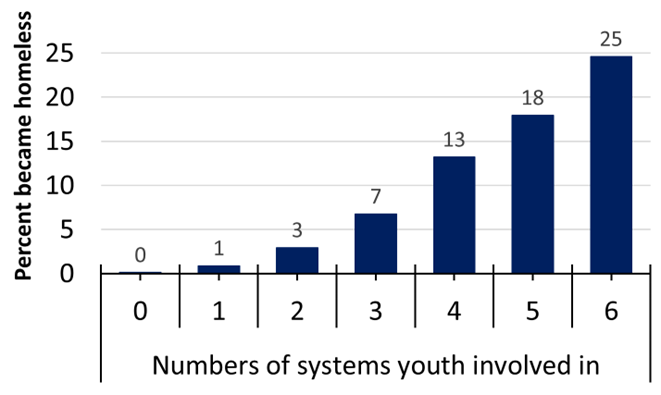
Children involved in more systems were more likely to be homeless, with 25% involved in six systems becoming homeless (Figure 1).
Both child and parent experiences were associated with increased risk. The strongest predictors were:
- Child welfare involvement;
- Not achieving a high school diploma;
- Family income assistance use; and,
- Child and parent mental health support for substance use or schizophrenia.
While youth involved in child welfare had an elevated risk, they accounted for only 37% of all youth who became homeless. This shows the need to consider multiple systems to prevent youth homelessness.
4. Youth with more intense systems involvement were at greater risk for homelessness.
Within each system, the risk of youth homelessness increased when children:
- Received support for more years. For example, 11% of children with one year of child welfare involvement and 16% of those with 4-6 years of involvement became homeless as youth;
- Were seen more times in the system. For example, 6% of children with one health care visit for substance use issues and 17% of those with three or more visits became homeless as youth;
- Were seen for more urgent needs. For example, 7% of children seen for physical abuse with low urgency needs in the MCFD Child and Youth Mental Health system and 17% of those with crisis needs became homeless as youth; and,
- Were seen for more issues. For example, 2% of children with one mental health care diagnosis and 19% of those with six mental health care diagnoses became homeless as youth.
For Government of British Columbia ministries, see the Full Analysis slide decks for more information.
5. Youth face potential gaps in housing support coverage.
Youth with greater systems involvement were more likely to receive other housing support. However, many youths who became homeless did not receive support (as of December 2022). This gap may improve with supports recently added in BC.
Among youth who received housing supports:
- Housing Connections (around 1/3 of placements): 46% of youth placed in housing experienced homelessness, but they only made up 9% of the homeless youth from the study;
- Homeless Individuals and Families Information System (HIFIS) Housing Supplements: 24% of youth who received supplements experienced homelessness, but they only made up 7% of the homeless youth from the study; and,
- Private Market Rent Supplements: 2% of youth who received supplements experienced homelessness, but they only made up 0.4% of the homeless youth from the study.
Policy Discussion
Framing the discussion
Policy discussion
The discussion centred on the following themes (Figure 2). These ideas need further development.
1. Youth to focus on
We discussed which youth to target for youth homelessness policy and programs.
- Youth with four or more system risks: Youth involved in more systems had increased risk for homelessness. This group is small enough to target effectively and already have connections to systems to support them.
- Youth involved in child welfare: Youth in care have a higher risk of homelessness. BC has many established supports for these youths, which provides a foundation for prevention.
- Youth with mental health needs: Youth with mental health needs such as schizophrenia, substance use, multiple mental health diagnoses, and long-term support are at a greater risk of homelessness. Targeting these youth allows programs to be focused and build on existing services.
- Critical youth transitions: Youth leaving systems like child welfare, corrections, mental health, or substance use treatment are at higher risk for homelessness. These transition points are easy to identify and are key opportunities for support

2. How to support youth
The discussion highlighted three main ways to support youth.
- Meet youth needs: One policy challenge is that youth who used more services had worse outcomes, suggesting the need for early and adequate support. Efficient policy solutions should consider how to get youth the right services, at the right time. It is more cost-effective to support needs early, than waiting until issues require more support.
Examples include:
i. Housing First for Youth places youth in housing with minimum conditions to meet urgent housing needs and facilitates other supports.8
ii. Upstream Canada uses a school screening tool to detect youth at risk and direct supports before a crisis occurs.9 This program has been piloted as Upstream Kelowna.10
- Coordinate supports: Coordinated services improve options, reduce wait times, and help youth navigate complex systems.4
Examples include:
i. PolicyWise is supporting work in Calgary to develop a collaborative approach to meet youth needs. Learn more at the website.11
ii. The Youth Agency Collaboration coordinated across Edmonton to support youth needs.12
iii. CHAIN (Combined Homelessness and Information Network) shares information across agencies about rough sleepers to better meet their needs and reduce effort duplication.13
- Support families: Family outcomes were connected to youths’ risks for homelessness, showing the importance of supports aimed at families. MFCD and other systems often have a family component to their programs and supports that could be expanded to support youth.
Examples include:
i. Family and Natural Support approaches work to strengthen youths’ relationships with their family and other important adults.14
ii. Reconnect provides school-based supports. They help youth stay connected to their family, community, school, and other important adults.15
3. Data for prevention
Data can support prevention in the following ways. More data uses are discussed in our previous work.4
- Detect risks: Data can help identify youth at risk of homelessness. For example, data on: the number of systems youth are involved in, severity of mental health needs, housing instability, and transition concerns. Asking youth about housing access across systems could be beneficial if paired with support. Trust and comfort affect how honestly youth answer risk questions. 5, 6, 7
- Share information: Sharing data helps coordinate services to meet youth needs more effectively. This can take many forms, from warm handoffs to community tables to data sharing that supports case coordination. Youth support safe and consent-based information sharing. 5, 7
Examples include:
i. BC Situation Tables are community led, bringing together frontline workers from many sectors to help people and families at risk.16 This can include public safety, health, and social services. Youth specific tables are needed.
ii. Community Information Exchanges (CIEs) share data to coordinate between systems.17 Some examples exist in Canada.18, 19 Coordinating data across systems helps meet youth needs more effectively.
- Continue using the Data Innovation Program (DIP) data: Our project is a starting point for youth homelessness prevention work in the DIP. So far, the focus has been on Housing and Municipal Affairs, but more analyses are possible and will increase as more data is available.
- Learn from change: We heard there is interest in evaluating policies and programs. More detailed DIP data would be needed, but reviewing policy and program outcomes using non-DIP data can provide useful insights and guide improvements.

Considerations moving forward
Policy discussions should consider the overall impact of youth homelessness. In Vancouver, the cost to support homeless people with mental health needs was estimated at $53,144 per year.20 Youth who became homeless face many other outcomes that carry additional costs. Next, youth homelessness prevention approaches are growing across Canada and can inform policy change.4, 21, 22 Finally, policy decisions benefit from involving those directly affected, especially youth with lived experience, to create solutions that address their realities.4
References
- Government of British Columbia. (2024, July). Data Innovation Program. https://www2.gov.bc.ca/gov/content/data/finding-and-sharing/data-innovation-program.
- Government of British Columbia. (2025, September). Preventing and reducing homelessness: An integrated data project. https://www2.gov.bc.ca/gov/content/housing-tenancy/affordable-and-social-housing/homelessness/homelessness-cohort.
- Statistics Canada. (2019). General Social Survey (Cycle 34), Victimizations (DSS Data production case: SCS-802 / 1156972) [Data set]. https://www.statcan.gc.ca/en/statistical-programs/document/4504_D1_V1.
- PolicyWise for Children & Families. (2025). A Data Infrastructure Roadmap for Preventing Youth Homelessness. https://policywise.com/a-data-roadmap-for-preventing-youth-homelessness/.
- Yamaguchi, et al. (2024). A Roadmap for Youth Homelessness Data Infrastructure – Supplement 5: Youth Focus Groups. Edmonton: PolicyWise for Children & Families. https://policywise.com/wp-content/uploads/2024/10/Supplement-5-Youth-focus-groups.pdf.
- Yamaguchi, et al. (2024). A Roadmap for Youth Homelessness Data Infrastructure – Supplement 4: Community Service Provider Interviews. Edmonton: PolicyWise for Children & Families. https://policywise.com/wp-content/uploads/2024/10/Supplement-4-Community-Service-Provider-Interviews.pdf.
- Yamaguchi, S., Russell, et al. (2025). Towards youth-centered information practices to support youth facing homelessness: Experiences and perspectives of youth with lived experience and community service providers. Journal of Social Distress and Homelessness. https://www.tandfonline.com/doi/full/10.1080/10530789.2025.2485686.
- Homeless Hub. (n.d.). Housing First for Youth. Retrieved February 11, 2026, from https://homelesshub.ca/collection/programs-that-work/housing-first-for-youth/.
- Homeless Hub. (n.d.). Upstream Canada. Retrieved February 11, 2026, from https://homelesshub.ca/collection/programs-that-work/upstream/.
- Boys and Girls Club Okanagan. (2021, February). BGC Okanagan launch preventative approach to youth homelessness in Kelowna. https://www.bgco.ca/bgc-okanagan-launch-preventative-approach-to-youth-homelessness-in-kelowna/.
- PolicyWise for Children & Families. (2026, January). Building Youth Homelessness Data Collaboration. https://policywise.com/building-youth-homelessness-data-collaboration/.
- MAPS AB. (n.d.). Youth Agency Collaboration. Retrieved February 11, 2026, from https://mapsab.ca/yac/.
- Homeless Link. (n.d.). CHAIN. Retrieved February 11, 2026, from https://homeless.org.uk/what-we-do/streetlink-and-chain/chain/.
- Homeless Hub. (n.d.). Retrieved February 11, 2026, from Family and Natural Supports. https://homelesshub.ca/collection/programs-that-work/family-and-natural-supports/.
- Homeless Hub. (n.d.). Reconnect. Retrieved February 11, 2026, from https://homelesshub.ca/collection/programs-that-work/reconnect/.
- Government of British Columbia. (2025, February). Situation Tables. https://www2.gov.bc.ca/gov/content/justice/criminal-justice/policing-in-bc/collaborative-public-safety-program/situation-tables.
- CIE San Diego. (n.d.). Community Information Exchange. Retrieved February 11, 2026, from https://ciesandiego.org/.
- South Georgian Bay Ontario Health Team. (n.d.). Community Information Exchange. Retrieved February 11, 2026, from https://southgeorgianbayoht.ca/community-information-exchange/.
- Distress Centre Calgary. (n.d.). Community Information Exchange. Retrieved February 11, 2026, from https://distresscentre.com/resources/community-information-exchange/.
- Latimer, E. A., et al. (2017). Costs of services for homeless people with mental illness in 5 Canadian cities: a large prospective follow-up study. CMAJ open, 5(3), E576–E585. https://pubmed.ncbi.nlm.nih.gov/28724726/.
- Homeless Hub. (n.d.). Youth Homelessness Prevention. Retrieved February 11, 2026, from https://homelesshub.ca/collection/prevention/youth-homelessness-prevention/.
- Making the Shift. (n.d.). Our Youth Homelessness Prevention Legacy. Retrieved February 11, 2026, from https://makingtheshiftinc.ca/.
Appendix
Selected related ongoing BC work
The advisory team reflected on ongoing BC programs and policies that connect to prevention. We briefly introduce these to support policy discussion, based on the earliest prevention period they focus on. This list is not exhaustive.
1. Childhood
- Erase (expect respect & a safe education): Helps students, adults, and school staff build safe, caring and inclusive school communities.
- Mental Health in Schools Strategy: The Ministry of Education and Child Care’s approach to mental health promotion in schools.
- Integrated Child & Youth Teams: Part of BC’s work to build a comprehensive mental health and addictions system of care. It brings services together in a multidisciplinary team setting.
- Integrated Youth Services (by Foundry BC): Supports young people aged 12 to 25 (some up to 29) years old in many parts of their lives. This can include help with mental health, substance use, physical and sexual health, making friends, learning important skills, and with school and employment.
- Youth Substance Use Beds: Bed-based services that support youths’ substance use treatment goals. These services are part of a journey to wellness, starting with connection to health authority services.
2. Transition to adulthood
- Youth Mental Health Transition Protocol (Y2A): Supports youth aged 17 to 20 years old and their families to experience improved mental health outcomes in the transition to adulthood. It uses coordinated, continuous, and responsive service planning and support.
- SAJE (Strengthening Abilities and Journeys of Empowerment): Comprehensive program for youth with child welfare care involvement to support a successful transition into adulthood.
3. Adulthood
- Complex Care Housing: Supports people living with significant mental health, addictions, or concurrent challenges, and other functional needs, who are at risk for homelessness.
Acknowledgments
It is with thanks that we acknowledge the many individuals who have contributed their wisdom, experience, and perspectives to this project. This project was built on collaborative learning, and we would like to thank the people who worked with us. Specifically, we would like to thank the staff from the Government of British Columbia that supported this project.
All inferences, opinions, and conclusions drawn in these materials are those of the authors. They do not reflect the opinions or policies of the provider(s) of the data upon which they are based. Further information on the data sets used for this project is at: https://catalogue.data.gov.bc.ca/organization/data-innovation-program-dip.
Project Partners
PolicyWise for Children & Families is proud to be collaborating with Dr. Carla Hilario, PhD from the University of British Columbia – Okanagan on this report.

Project Funding
This project was funded in part by the Government of Canada and the Government of British Columbia.