Youth experiencing homelessness often move between social service agencies, shelters, and government programs. When those services are not connected, youth repeat their story. Assessments also get duplicated, and referrals take longer. Responsible data sharing for youth homelessness services can help staff coordinate support, reduce duplication, and identify youth at risk earlier.
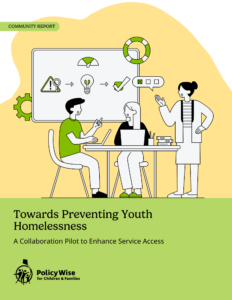
PolicyWise for Children & Families’ new community report, Towards Preventing Youth Homelessness: A Collaboration Pilot to Enhance Service Access, shares what we learned from a pilot in Calgary with The Alex and the Trellis Society. The pilot focused on developing a collaboration across the two agencies, resulting in a partnership between The Alex’s Youth Health Bus and Trellis’ All in For Youth programs. The report summarizes what was tested, what partners learned along the way, and what helped them stay on track.
If you are exploring responsible data sharing for youth homelessness services, start with the full report here.

Why responsible data sharing matters for youth homelessness services
For youth experiencing homelessness, the issue is not only whether services exist. It is whether services connect. When information does not move with the young person, youth are often asked to repeat their story at each service point. Staff may not have what they need to make informed referrals or coordinate next steps. The result is delays, duplication, and missed context.
Responsible data sharing is not about sharing everything. It is about sharing the right information in the right way, with a clear purpose and clear consent. The Calgary work reinforced a key point. Data sharing only works when partners have trust, shared goals, and clear expectations, not just tools or technology.
What the Calgary youth homelessness pilot did
The Calgary youth homelessness pilot focused on building a workable partnership between The Alex and Trellis to help coordinate services. The two organizations started by looking at what already happens in practice. This included intake steps, consent procedures, referral pathways, and data systems. To identify realistic points of coordination, they also examined how they collected, used, and stored client information.
The next step for the partners was forming a working group and asked staff to map a typical client journey from first contact through transition or exit. They compared the likely benefit of each idea with the time and effort it would take. Then, they chose what fit their current capacity and timelines.

Implementation started with practical steps that helped staff build relationships and knowledge between the organizations. Peer walkthroughs helped teams learn how each program operates day to day. A focused “Lunch and Learn” session helped teams plan how program coordination would work. The session also helped clarify shared language, since “data sharing” can mean different things to different people. The work then narrowed to two programs with clear overlap in Calgary high schools, The Alex’s Youth Health Bus and Trellis’ All in For Youth.
What changed in practice was straightforward. Partners strengthened cross-organizational relationships and planned a shared contact list to support smoother referrals. They also determined how they will obtain client consent to share data. These steps are all aimed at reducing repeated storytelling, closing the loop on referrals, and connecting youth to needed services sooner. This is the kind of on-the-ground work that makes referrals between youth homelessness and prevention services more consistent and supports straightforward handoffs.
Key lessons agencies can use now
The report’s lessons are practical for organizations considering responsible data sharing.
- Start with trust and shared understanding. Data sharing depends on relationships, and that takes time and structure.
- Be honest about readiness. Differences in infrastructure, comfort with data, and perceived privacy risk shape what is possible.
- Define purpose, scope, and language early. Without shared terms and clear intent, collaboration drifts, and confusion grows.
- Bring the right people in at the right time. Progress improves when operational staff and decision makers are involved when choices are being made.
- Use simple tools to keep momentum. Agendas, templates, decision frameworks, and clear notes help partners track decisions and next steps.
Use the report to help build coordinated service access for youth experiencing homelessness
Our report shows how to build collaborations between organizations serving youth at risk of or experiencing homelessness. It offers an approach that your organization can use to improve service access and reduce duplication.
Take a look at our report and see the steps the Calgary partners took to make coordination more workable.
Project partners
PolicyWise for Children & Families is proud to be collaborating with The Alex and the Trellis Society on this project.


Project funding
This project was funded in part by the Government of Canada.